


If you’re applying for a role within your current company, you already have an advantage over external candidates.
However, you still need a strong resume tailored to the internal position to convince the hiring manager that you’re ready to take on new responsibilities.
In this guide, you’ll learn:
- What to do before writing your resume
- What skills, experience, and education to include
- Common mistakes to avoid
To make the process even faster, try our free online resume builder and get instant suggestions that’ll help your resume stand out.
The Value of Staying in the Same Company in Today’s Job Market
Staying with the same employer is becoming more common in today’s job market. According to the U.S. Bureau of Labor Statistics (BLS), the median time workers spend with their current employer is 3.9 years, with those in management roles averaging 5.7 years
Also, reports show that switching jobs is not as profitable as it used to be, which is causing fewer people to change employers.
This makes applying for an internal position or promotion a smart move for advancing your career.
It’s a great way to show your commitment and take advantage of growth opportunities without the uncertainty of starting somewhere entirely new.
What To Do Before Writing Your Resume for an Internal Promotion
Before applying for an internal position, your resume must meet the requirements of the role you’re trying to secure.
Since you’re already in the company, you’ll want to use your home-field advantage.
There are some great ways to prepare to write an effective resume that will secure the promotion.
1. Study the job opening
When you see that your company has an opening for a position that you want to apply for, you should properly analyze the job description.
You can do that by:
- Reading it thoroughly to get a better understanding of the required skills and qualifications.
- Identifying keywords in the job description that you could use in your resume to highlight your relevant experience and skills.
- Thinking about how to tailor your resume to the specific job and emphasizing your experiences that align with the job requirements.
That way, you’ll know precisely how to personalize your internal job resume and include information that the hiring manager really wants to see.
2. Talk to your coworkers
Don’t forget to network with the other people in your company, either.
If you’re close with a coworker who knows the position well, fantastic!
Even if you aren’t spending your coffee breaks with someone who knows what the job opening entails, you can still ask the right people a few questions.
You should also try to reach out to the people close to the hiring manager, or even directly to the hiring manager themselves.
You can ask for a meeting to show your interest and find out more information about the day-to-day in the role.
Finally, you could try to get a recommendation letter from a coworker. This is a great way of using your position on the inside to secure the internal vacancy.
Internal Promotion Resume Example
If you have any doubts about how to write a resume for an internal position, you should look over a sample.
Review the following sample resume for an internal job posting to get an idea of what you should include to be successful.
[George Robinson]
[Accountant]
[Denver, CO, 54511 | (555) 678-5555 | GRob345@randomemail.com]
Summary
Results-driven accountant with over 5 years of experience at Smith & Jones Accounting, specializing in auditing and public accounting. Proven ability to optimize financial processes, having saved the firm $70,000 through process improvements. Adept at mentoring junior accountants and improving team productivity by 25%.
Skills
- Advanced invoice coding
- Financial data analysis
- Process improvement
- Knowledge of accounting regulations
- Proficiency in accounting software (QuickBooks, SAP)
- Strong communication and leadership skills
- Time management and organization
Experience
Accountant
ABC Accounting | Accountant | Denver, CO
2020-Present
- Trained and mentored 5 junior accountants, boosting team productivity by 25% and achieving a 100% retention rate.
- Conducted a comprehensive review of accounting procedures that reducing errors by 15% and increased overall efficiency by 20%.
- Identified and corrected accounting discrepancies that generated $70,000 in savings for the firm.
- Collaborated with cross-functional teams to streamline financial reporting processes and improved report accuracy and timeliness.
Education & Certification
University of Colorado | Master of Science in Accounting
University of Colorado | Bachelor of Science in Accounting & Finance
Certified Public Accountant (CPA) – 2019
Skills
- Advanced invoice coding
- Financial data analysis
- Process improvement
- Knowledge of accounting regulations
- Proficiency in accounting software (QuickBooks, SAP)
- Strong communication and leadership skills
- Time management and organization
In addition to studying this example, you can use a handy internal job resume template to help you quickly structure your application.
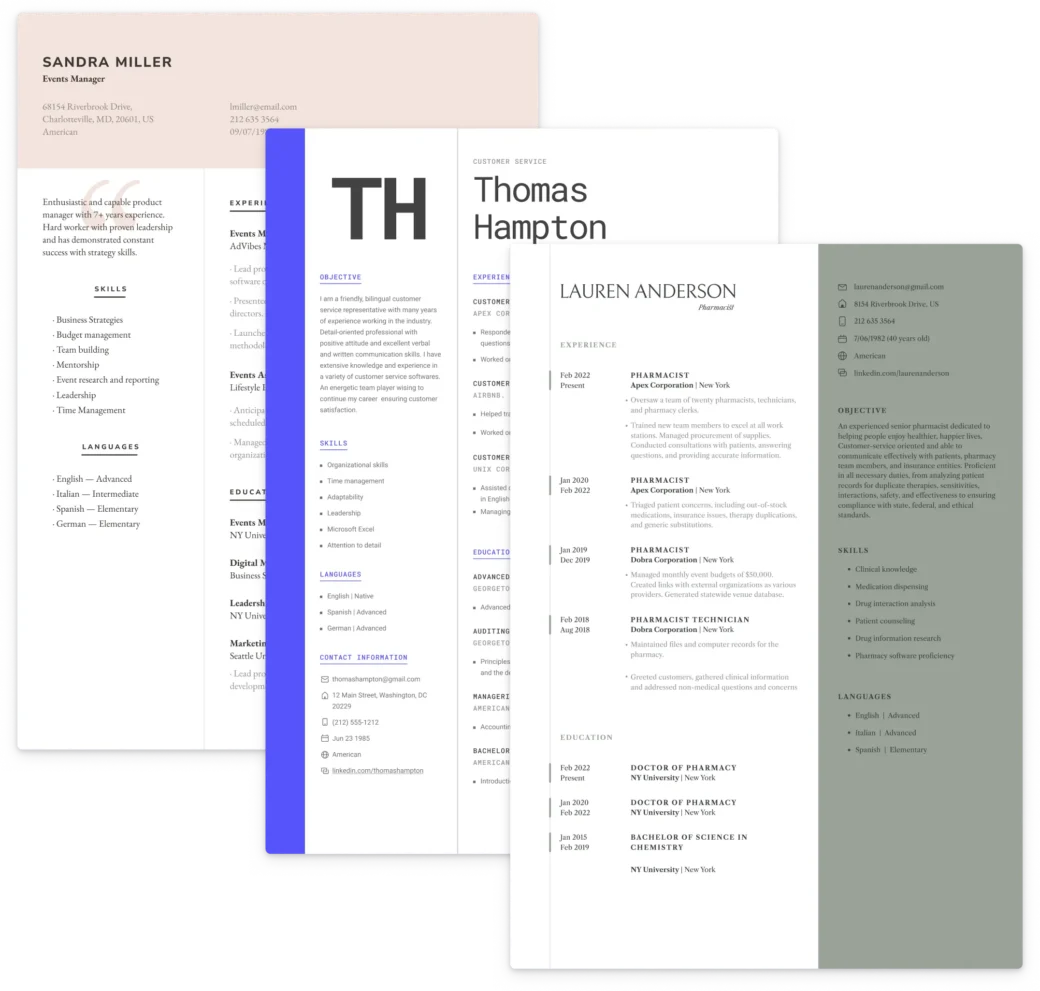
Build your perfect resume with ease
Craft the perfect resume effortlessly with our builder. Get started today!
Tips for Writing a Resume for an Internal Position
When applying for a promotion or transfer within your company, it’s important to focus on how you’ve contributed to the organization.
Even though you’re already familiar with the company, your resume needs to clearly show why you’re the best fit for the new role.
Highlight your achievements and the value you’ve added to your organization.
1. Showcase your impact on the company
One of the biggest advantages when writing a resume for a promotion within the same company is that you can highlight specific accomplishments from your time there. To make your resume stand out, focus on quantifying your achievements.
For example, instead of just saying you improved processes, use metrics like “increased team efficiency by 20%” or “implemented a new system that reduced response times by 30%.”
By using measurable results, you can clearly demonstrate how you’ve helped the company and why you’re ready for a promotion within the same company.
This approach will strengthen your resume and make a compelling case for advancing to the next level.
2. Update your resume summary
Your summary is the part of the resume where you have your first opportunity to grab the hiring manager’s attention.
After all, a resume summary is the first thing they read, as it goes at the top, just under your contact info.
Let’s look at how you should and shouldn’t write your summary.
Wrong ❌
Accountant with more than two years of experience. Monitored financial statements and business with a commitment to the best accounting practices.
This is too generic and doesn’t give any specific data. You’ll want to really show off what you’ve done for your company with some strong action words to get that promotion.
Take advantage of our free resume summary generator to avoid mistakes like this.
When writing a resume for an internal position or a promotion within the same company, it’s important to strike a balance between highlighting your current responsibilities and showing how you can add value in the new role.
Let’s now look at a good example:
Right ✅
Results-driven Marketing Coordinator with 5 years of experience at Springfield Solutions, specializing in digital marketing, brand management, and multi-channel campaign execution. Proven track record of increasing online engagement by 30% and boosting lead generation by 25% through data-driven strategies and creative content development. Adept at managing cross-functional projects, optimizing digital presence, and supporting brand growth in fast-paced environments.
That’s much more like it!
This example mentions how the candidate specifically helped their company improve online engagement and lead generation. It directly demonstrates the value they’ve already delivered to the company, which shows their potential for the future, too.
3. Include relevant skills for an internal promotion
Understanding how to transfer to another job within the same company means you should also know your company’s ideology and culture. This can really help you recognize which skills to list on your resume.
You may be going for a completely different role, but perhaps there are some soft skills that your company really values.
To ensure that you add the correct skills to your resume skills section, you should do the following:
- Study the job description to add your most relevant transferable skills.
- Add soft skills that match your company’s culture, like patience or collaboration.
If the position you want is similar to your current role, you can mention how your skills have led to success within your experience section, for example:
Used data analysis skills to track campaign performance and make data-driven decisions to optimize results.
4. Fill the Experience section with company wins
When writing an internal position experience section, it’s critical to showcase your accomplishments over the years within the company.
Ensure you mention what you’ve done with the data to back it up. If you’ve already changed positions or advanced within the company in the past, make sure that’s added as well.
The following is an unimpressive Experience section of an internal resume example
Wrong ❌
OMG Travel Agency February
Travel Agent 2018 – Present
- Worked as a travel agent at OMG Travel Agency since 2018. Helped clients to reach their destinations and provided great deals in the process.
This doesn’t tell nearly the whole story.
How satisfied were your customers? How much money did you make? These are the types of questions you should be answering in your experience section.
Right ✅
OMG Travel Agency February
Travel Agent 2018 – Present
- Consistently exceeded sales targets by 10-17% and made the most bookings in the department in 2019 and 2021.
- Received a 5/5 rating from 95% of clients, resulting in over 30% of clients returning within 7 months to book another trip.
- Provided personalized recommendations to 50+ clients per month, achieving a 95% satisfaction rating through strong communication, negotiation, and organization skills.
- Researched destinations, accommodations, and activities to build tailored itineraries that elevated the client experience and drove a 20% increase in repeat bookings.
This will definitely have a greater impact on the hiring manager and get your resume in that ‘to interview’ pile. It includes concrete data on achievements, outlines soft skills, and demonstrates how the candidate has added value to the company by conducting new research.
5. Retouch the Education section
If you have a new degree or certification or have attended a relevant training session, you should add these to your education section.
Don’t forget to include the full title of the qualification you earned and where you studied for it (which could be simply ‘online’ if you did a virtual study course).
Use our resume checker to make sure your Education section in your internal resume is well-tailored to the job you are applying for.
Key Points
Securing a new role within your own company is never a given, but if you have the opportunity, it’s often worth pursuing!
To give yourself the best chance at success, make sure your resume for internal promotion stands out by following these key tips:
- Study the job opening and talk to coworkers or managers in the department to understand what’s valued in the new role.
- Use a format that highlights your progress and growth within the company.
- Showcase how you’ve made an impact by quantifying your achievements—use data like “increased team efficiency by 20%” or “reduced costs by 15%.”
- Tailor your resume to include skills that align with your company’s values and the specific needs of the department you’re applying to.
By incorporating these elements, your resume for a promotion will be more impactful, helping you stand out and impress your employer.
FAQs
To apply for an internal promotion, continually check your company’s job postings and submit your updated resume and cover letter highlighting your achievements and growth within the organization.
Make sure that you emphasize results and skills relevant to the new role you want to apply for. Then, communicate your interest to your manager or HR, and prepare to discuss how your experience aligns with the team’s goals and future success.
Internal promotions typically happen when a company fills a higher-level position with an existing employee. Candidates are evaluated based on performance and potential for growth.
On occasion, companies may even create new roles to promote employees.
Promotions help retain talent and strengthen company culture by offering career advancement opportunities within the organization.
If you’re offered an internal promotion, start by researching typical pay ranges for the new role using sites like Glassdoor or Payscale, and compare them with your company’s pay bands if available.
Review similar job postings, speak discreetly with mentors about standard ranges, and look at your past performance reviews to understand where you fit.
Then, present a clear, professional case for your value by highlighting measurable achievements, and stay open to discussing salary or title.
You could present it in a brief, professional meeting where you share the market range you found, explain where you fit based on your research, and link your request to the impact you’ve made and the responsibilities of the new role.
Related Posts